Think Business Credit Cards Aren’t for You? Read This First.

One of the biggest misconceptions we hear about business credit cards is:
“I can’t get one. I don’t own a business.”
But when most people hear business, they picture an LLC, employees, an office and someone calling themselves CEO. 😂
That’s not the only kind of business that may qualify.
If you earn money — or legitimately operate a side business with the intention of earning money — you may be able to apply for a business credit card as a sole proprietor.
You don’t necessarily need an LLC, employees, an office or even a separate business name.
And you may already be doing something that counts without thinking of yourself as a business owner.
Affiliate disclosure: Moms Chasing Miles may receive compensation if you apply for a credit card through links on this page. This does not affect our opinions or recommendations. Offers are subject to change. Always review the issuer’s current terms before applying.
What Is a Sole Proprietor?
A sole proprietorship is one of the simplest ways to operate a business.
In many cases, the business is simply you.
You may still have tax, licensing or registration requirements depending on what you do and where you live, but you do not necessarily need to form an LLC just to apply for a business credit card.
You May Have a Business Without Realizing It
Think about whether you make — or legitimately intend to make — money doing something on your own.
That could include:
Babysitting
Pet sitting
Tutoring
Photography
Lawn care
Freelance writing or design
Social media management
Content creation
Consulting
Uber, Lyft or delivery driving
Selling products online
Etsy
Reselling items for profit
Vacation rentals
Handyman or other service work
You don’t have to leave your full-time job.
Your business doesn’t have to make thousands of dollars a month.
And it definitely doesn’t need an office.
One important rule
Your business should be legitimate, and everything you put on the application should be accurate.
Don’t invent a business or inflate your revenue because you think it will improve your chances of approval.
If you’re unsure whether your activity qualifies as a business for legal or tax purposes, talk with a qualified professional.
What If My Business Barely Makes Any Money?
A small amount of revenue doesn’t automatically disqualify you.
New businesses may earn very little, and some may not have earned revenue yet.
If an application asks for your business revenue, enter the actual number.
If you made $500, enter $500.
If the truthful answer is $0 and the application allows $0, enter $0.
Approval is never guaranteed, but you don’t need to make your business sound bigger than it actually is.
How to Apply as a Sole Proprietor
This is usually where people get intimidated.
The application starts asking for:
Business name.
Tax ID.
Revenue.
Years in business.
Employees.
And suddenly it feels like you need a whole corporation.
You probably don’t.
Want to make this even easier? Screenshot the example below and keep it handy while you apply. It shows how some of the most common business application fields may look for a sole proprietor, so you can refer back to it as you go.
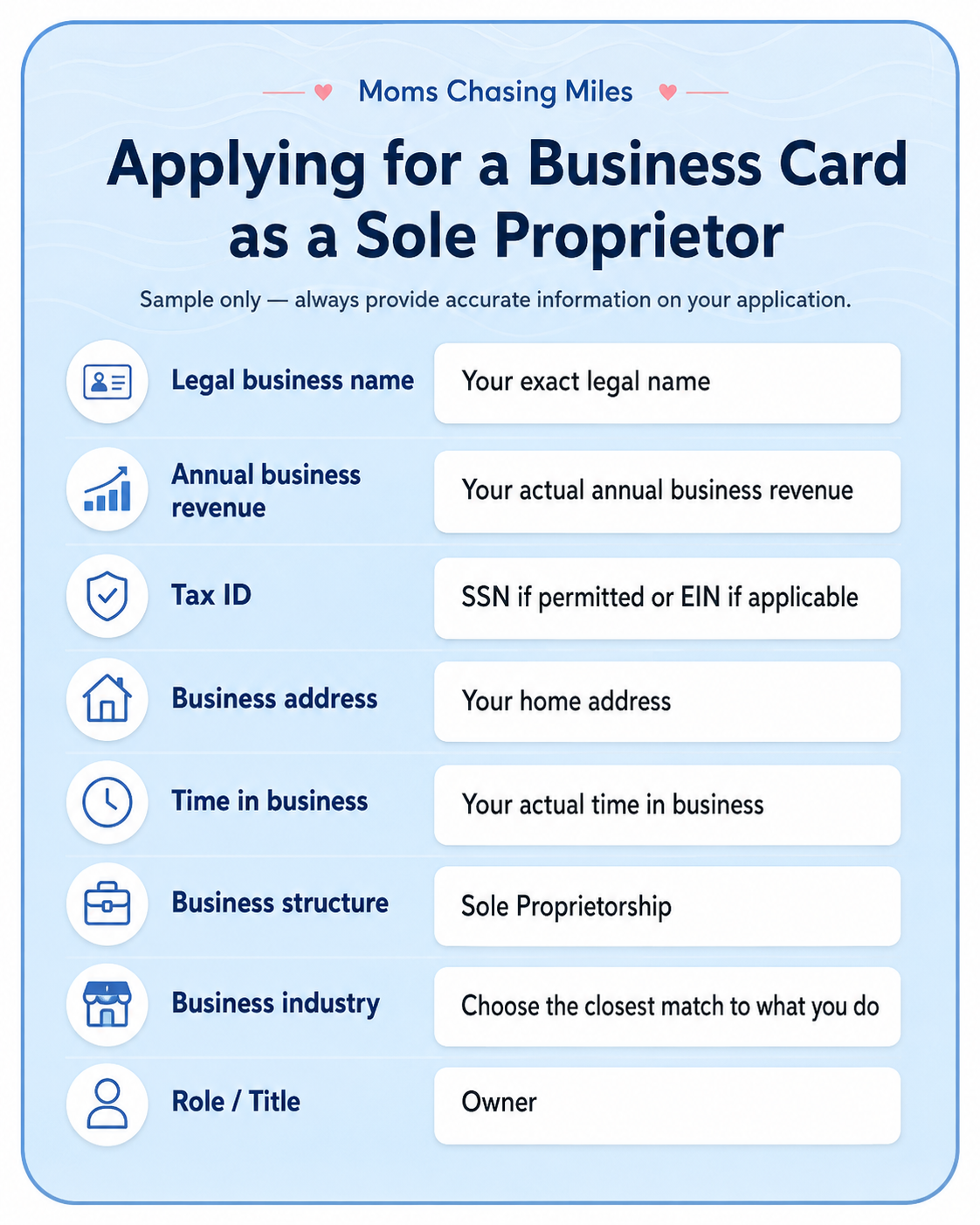
Sample only — applications vary by issuer. Always provide accurate information based on your actual business.
Here’s what some common fields may look like:
Legal business name: Your legal first and last name
Business structure: Sole Proprietorship
Business address: Your home address if that’s where you operate the business
Business phone: Your personal phone number if you don’t have a separate business line
Role/title: Owner
Tax ID: Some issuers allow sole proprietors to use an SSN if they don’t have an EIN
Annual business revenue: Your actual revenue
Time in business: How long you’ve actually been operating
Industry: Choose the closest match to what you actually do
Watch the employee question
Read this one carefully.
Some applications ask for employees including yourself, while others ask for employees other than yourself.
Answer based on exactly how the question is worded.
What About Your Personal Credit?
Business cards aren’t necessarily completely separate from your personal credit.
The issuer may use your personal credit history when evaluating your application and may perform a hard inquiry.
Reporting policies also vary by issuer, so don’t assume a business card can never affect your personal credit.
Why We Like Having Business Cards as an Option
For people earning points and miles, business cards open up another category of cards to consider.
Depending on the card, you may find:
Welcome offers
Flexible points
Airline miles
Hotel points
Travel benefits
Bonus categories that match business spending
For us, business cards aren’t about running some huge company.
They’re simply another tool we can consider when the card fits our actual business, spending and travel goals.
Before You Apply
Being eligible to apply doesn’t automatically mean a card is a good fit.
Before opening one, we’d ask:
Can I meet the spending requirement with expenses I was already going to have?
Can I pay the balance without carrying interest?
Does this card actually help with my travel goals?
Am I eligible for the current welcome offer?
If you’re completely new to points and miles, start with our Free Beginner’s Guide first.
The Bottom Line
You don’t need employees, an office or “CEO” in your bio to potentially qualify for a business credit card.
Your business might happen after work.
It might happen on weekends.
It might run completely from your house.
And it might still be small.
The important part is that it’s legitimate and that you provide accurate information on the application.
So if you’ve always skipped right over business cards because you thought “those aren’t for me,” it might be time to take another look.



Opinions expressed here are the authors' alone, not those of any bank, credit card issuer, hotel, airline, or other entity. This content has not been reviewed, approved, or otherwise endorsed by any of the entities included within this post.